Every morning on the boat
- Read the DHMZ marine forecast and its warnings for Central Dalmatia. DHMZ marine forecast (Official source, )
- No signal? Listen on the VHF. Split Radio reads the weather at 07:45, 14:45, 21:45 and 02:45, Croatian summer time. (From the operator, )
- Look at the gusts, not the average, and pick tonight's harbour for the strongest wind in the forecast.
Which forecast to trust
Sailors in Croatia juggle five or six forecasts every morning. They don't carry the same weight. Start at the top of this list, and use the ones further down only to fill in detail.
- The DHMZ marine forecast and warnings
Use it to decide whether to sail, where to go and where to spend the night. It is the official forecast, written by forecasters in Split. (Official source, )
DHMZ gives green, yellow, orange and red warnings for each county and for the sea areas, among them Central Dalmatia (Srednja Dalmacija). (Official source, ) DHMZ marine forecast
- The coast radio and Navtex
Use it at sea, when you have no signal. It reads the same official forecast out on the VHF, and adds gale warnings between the set times. (Official source, )
The coast radio times and channels are below.
- DHMZ's wind maps
Use them to see where the wind is strongest, hour by hour, along your route. DHMZ's own model, ALADIN, runs four times a day and shows the wind hour by hour for 72 hours, with maps for the Split, Zadar, Dubrovnik and Kvarner areas. (Official source, )
Its forecast for sailors takes the wind from ALADIN and the waves from the European ECMWF model, and warns that the two can sometimes disagree. (Official source, )
- Global models in wind apps
Use them for the big picture a few days ahead. They run on a coarser grid, so they smooth out the local gusts off the mountains and inside summer storms.
If an app and the DHMZ text disagree, go with DHMZ and the stronger wind.
- Our wind and sea, next 3 days
Use it for a quick look at one harbour on our routes. It is a model forecast from Open-Meteo, shown as it comes, with no verdicts. Try it below
The winds, one by one
Four names come up on every forecast, and a fifth, the summer storm, is the one that catches sailors out.
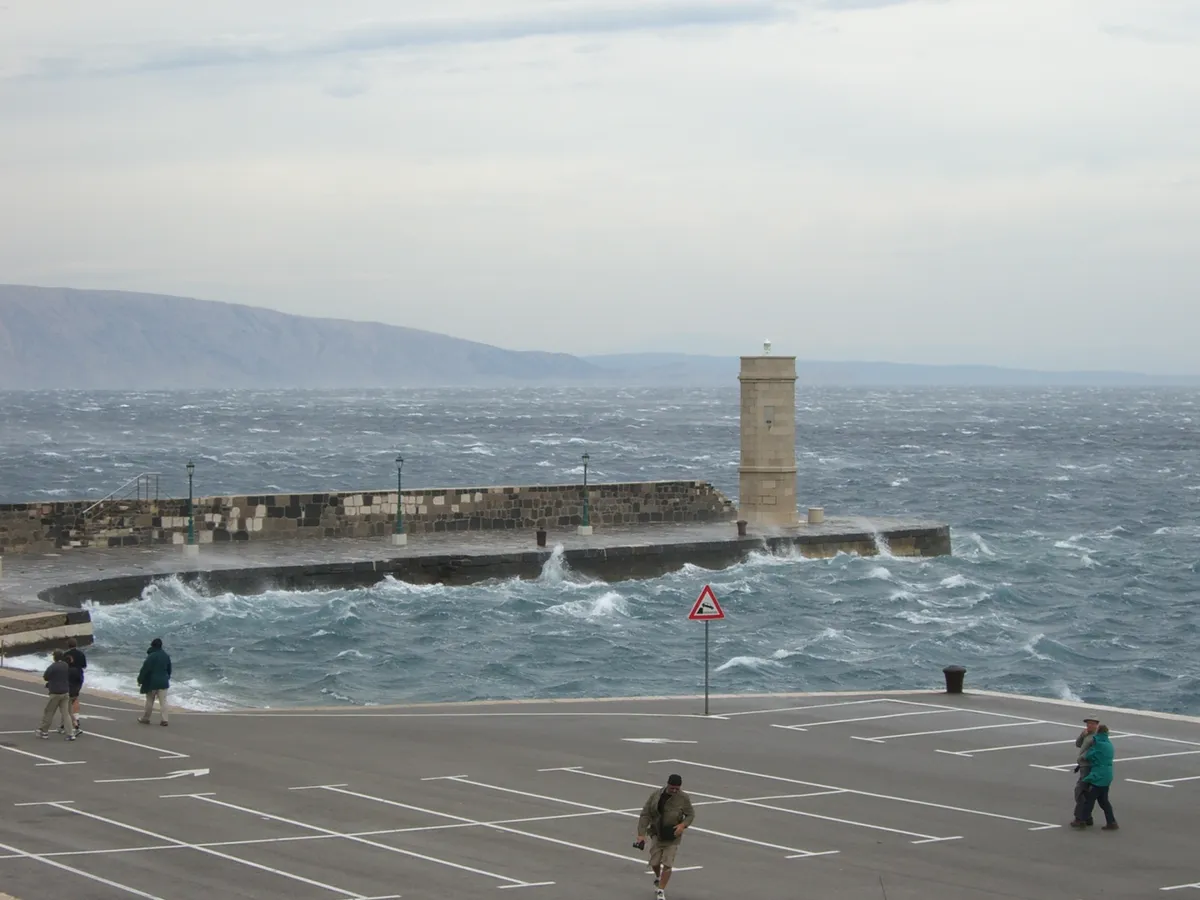

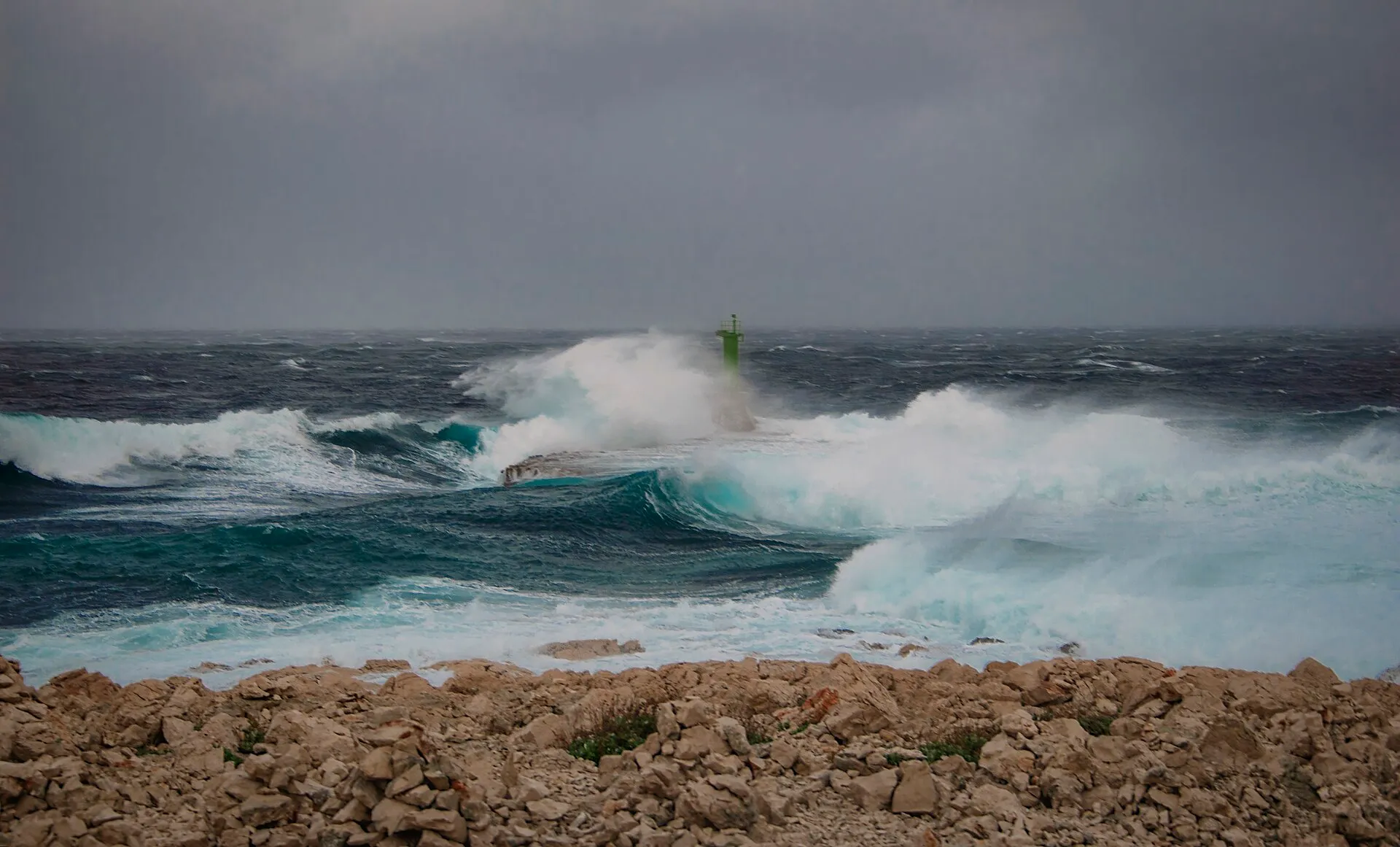
A bura day in Senj, on the northern coast under the Velebit mountains. The wind whips the sea white round the harbour breakwater.
- Burafrom the northeast
The bura (bora in English) is a cold, gusty wind that falls off the mountains. It is strongest close under the coastal mountains and can blow for days. Single bura gusts in Croatia have reached 69 m/s, about 134 knots, and the 10-minute average has passed 40 m/s, about 78 knots. (Official source, )
DHMZ's forecast for sailors looks three days ahead, but in the channels the bura can start suddenly, and it is stronger at night. Make for shelter at the first signs, and don't spend the night in a bay open to the north or northeast if one is forecast. (Third-party source, ) What a sailor told us
- Jugofrom the southeast
- A warm, humid wind, often with rain, that builds gradually and can blow for days, usually up to three in summer. It raises big waves on the open sea. Harbours and bays open to the south-east and south become unsafe: leave before it builds. It can keep you in port. (Third-party source, ) What a sailor told us
- Maestralfrom the northwest
- The summer north-westerly of fair weather. It starts in the morning, is strongest in the early afternoon and dies by sunset. It is the ideal sailing wind. (Third-party source, )
- Tramontanafrom the north
- A cold, dry north wind that comes with clear weather. It is stronger offshore, where it raises big waves, so a bay open to the north becomes a lee shore. (Third-party source, )
- Summer stormnevera, from any side
In summer, a passing cold front brings storms with strong mixing of the air, a sudden stronger wind, thunder and showers. (Official source, )
It comes fast and often passes within an hour, but the wind can swing right round and turn a calm bay into a lee shore. Watch the warnings, reef early and keep the engine ready. Safety at sea: when a storm is coming · What a sailor told us
What each wind does. Our cautious answer: weather descriptions, not a forecast: read DHMZ's forecast for sailors before you go. Our skipper reviewer hasn't checked this yet. The winds above are from DHMZ and the Croatian encyclopedia, with our own advice.
Which months are windiest
We counted the windy days in model data for the open sea west of Vis, on the way to the Blue Cave on Biševo. June is the calmest month. Spring and autumn bring the most wind, much of it from the jugo. (Measured by us, ) For crowds, sea temperature and prices in each month, read Best time to sail in Croatia, month by month.
| Month | Days with gusts of 25 kn or more | Days with 17 kn or more, from the | Strongest gust | ||
|---|---|---|---|---|---|
| Bura | Jugo | Maestral | |||
| Apr | 3 | 6 | 2 | 47 kn | |
| May | 3 | 7 | 1 | 44 kn | |
| Jun | 1 | 2 | 2 | 37 kn | |
| Jul | 1 | 2 | 4 | 34 kn | |
| Aug | 2 | 3 | 3 | 38 kn | |
| Sep | 1 | 5 | 3 | 40 kn | |
| Oct | 2 | 7 | 0 | 42 kn | |
Days with a gust of 25 knots or more on the open sea west of Vis, by month, 2021 to 2025, from a weather model. Each figure is the average over those years, rounded. A model smooths the wind. Real gusts, above all in summer storms and under the mountains, were often stronger. Not for navigation.
Reading the DHMZ marine forecast
- What it holds
- Each issue has a warning, a synopsis of the weather, a forecast for the next 12 hours and one for the 12 hours after, and the Beaufort and Douglas scales. (Official source, )
- Languages
- It comes in Croatian, English, German and Italian. (Official source, )
- Warnings
- DHMZ gives green, yellow, orange and red warnings for each county and for the sea areas, among them Central Dalmatia (Srednja Dalmacija). (Official source, )
- By Navtex
- DHMZ writes a 24-hour forecast for the northern, middle and southern Adriatic that goes out by Navtex in English on 518 kHz. (Official source, )
The wind words, in knots
| Beaufort | Words | Knots | What it means on a charter yacht |
|---|---|---|---|
| 4 | Moderate | 11 to 16 | Good sailing. Full sail on most boats. |
| 5 | Fresh | 17 to 21 | Reef early. Crossings get wet. |
| 6 | Strong | 22 to 27 | Hard work for a new crew. Stay in port or keep to sheltered water. |
| 7 | Near gale | 28 to 33 | Stay in a sheltered harbour. |
| 8 and up | Gale | 34 and up | Stay in port, with extra lines. |
"Locally up to" in the forecast means some places will get that much, often in gusts off the land. Plan for it.
Weather on the VHF
The three coast radio stations read the official forecast in English and Croatian at set times every day. The times are in UTC: add 2 hours in Croatian summer time, and 1 hour in winter. (From the operator, )
| Station | VHF channels | UTC | Summer time |
|---|---|---|---|
| Split RadioCentral Dalmatia | 07, 21, 23, 28, 81, 84 | 05:45, 12:45, 19:45, 00:45 | 07:45, 14:45, 21:45, 02:45 (From the operator, ) |
| Rijeka RadioIstria and Kvarner | 04, 19, 20, 23, 24, 81, 85 | 05:30, 12:30, 19:30, 00:30 | 07:30, 14:30, 21:30, 02:30 (From the operator, ) |
| Dubrovnik RadioSouth Dalmatia | 04, 07, 28, 85 | 06:20, 13:20, 20:20, 01:20 | 08:20, 15:20, 22:20, 03:20 (From the operator, ) |
- Gale warnings
- Between the set times, the coast radio stations read extra wind warnings: every 2 hours for winds of 30 to 50 knots, and every hour above 50 knots. (Official source, )
- Navtex
- Split Radio sends Navtex in English on 518 kHz at 02:40, 06:40, 10:40, 14:40, 18:40 and 22:40 UTC, and in Croatian on 490 kHz. (From the operator, )
- Harbourmasters
- The harbourmasters' offices and their branch offices use VHF channels 10 and 16, and channel 70 for DSC. (Official source, )Harbourmasters' offices broadcast weather reports on their own VHF channel, Split on channel 67. Our cautious answer: rely on the coast radio stations' scheduled broadcasts, and use this only as a backup. Our skipper reviewer hasn't checked this yet. (Third-party source, )
- In an emergency
- 195 for sea rescue (MRCC Rijeka). Free from a landline or a mobile, day and night. (Official source, )VHF channel 16 to ask for help at sea. (Official source, )112 for any emergency. At sea, 112 puts your call through to MRCC Rijeka, the sea rescue centre. (Official source, ) Safety at sea: who to call in an emergency
Wind and sea, next 3 days
Current model values are not available on this page yet. For wind and sea, read the official DHMZ forecast. It never says whether to go: that is your call.
Model forecast from Open-Meteo.Not an official forecast. Not for navigation.
Official forecast: DHMZ marine forecast (Official source, )
How to read this forecast
- Each part of the day shows its strongest hourly wind, the direction at that hour, its strongest gust and its highest wave. Today counts only the hours still to come.
- Morning is 06:00 to 12:00, afternoon 12:00 to 18:00 and evening 18:00 to midnight, Croatian time.
- The words follow the Beaufort scale: light is under 11 kn, moderate 11 to 16 kn, fresh 17 to 21 kn, strong 22 to 33 kn and gale 34 kn or more.
- A local name is added when a moderate or stronger wind blows from that wind's usual direction. The model can't tell a real bura from any other northeast wind.
- The model gives the wind over open water near each point. In a harbour or under high ground it can be calmer, or much gustier.
- Wave height, where the model has it, is its significant wave height: the average of the highest third of the waves. Single waves can be much higher.
Weather data by Open-Meteo.com, CC BY 4.0. Grouped into parts of the day by OlaSail.
Each harbour in the picker has its own page: Split, Maslinica, Vis town, Komiža, Palmižana, Hvar town, Stari Grad, Milna.
Choosing tonight's harbour
Most bad nights come from being in the right harbour for the wrong wind. Read the forecast in the afternoon, and look at the direction of the strongest wind it gives for the night. Then check which way your harbour is open. Our route Seven days from Split gives a Plan B for each day's wind.
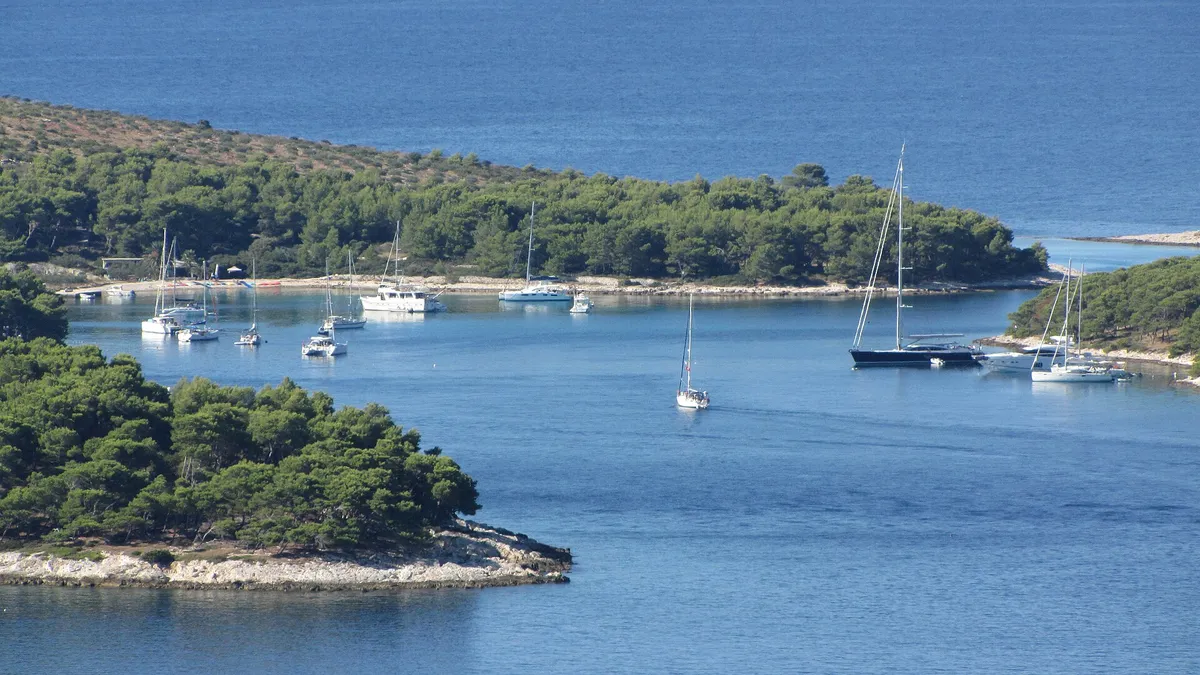
Open to the bura. The bay is well sheltered from every other wind, the operator says. (From the operator, )
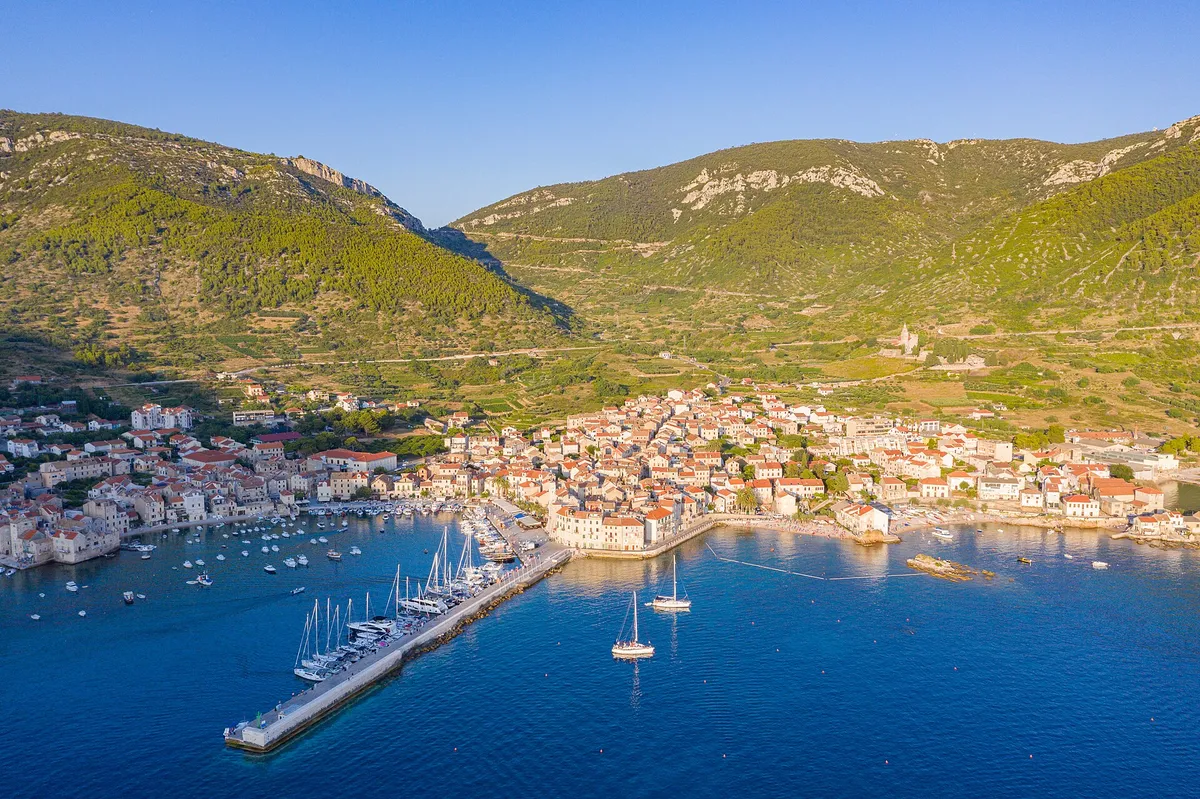
Komiža bay is open to the west and south-west, and these winds raise high waves in it (Third-party source, ). Berths inside the breakwater are sheltered (Third-party source, ). Its buoys lie close together, are open to westerlies, and take swell in any wind with south in it. A bura blows across them in shifting gusts but raises no waves. (Third-party source, ) Our cautious answer: if a westerly, south-westerly or thunderstorm is forecast, lie inside the breakwater or go round to Vis town. Our skipper reviewer hasn't checked this yet.
Vis harbour is open to the bura and the jugo, and every wind blows hard here, the bura and the jugo most of all. (Third-party source, ) Our cautious answer: in a bura or a jugo expect a rough night on the town quay, and strong gusts in any other wind. Our skipper reviewer hasn't checked this yet. The Kut side is open to northerly and north-westerly winds. (Third-party source, ) Our cautious answer: in a strong maestral expect Kut to be the more exposed side. Our skipper reviewer hasn't checked this yet.
In strong winds, boats further out in Stari Grad bay should seek shelter in Stari Grad itself. In Zavala, a cove on the Kabal shore 1.7 NM north-west of the town, the bura and jugo can blow hard but raise no high waves, though a north-westerly makes a rough sea; Tiha, further out, is a good anchorage in all winds of moderate strength. (Official source, )
Shelter comes from the operator or an official source, and our skipper reviewer checks it on the water. The other harbours on Vis, each with its shelter, are on Vis by boat, and those on Hvar on Hvar by boat. Before you anchor in a bay, read Anchoring in Croatia: the rules and the fees.
Common questions
- Which weather forecast should I use for sailing in Croatia?
- The DHMZ marine forecast and its warnings, every morning and before each crossing. Use apps only to see where the gusts are. (Official source, )
- How much warning do you get of a bura?
- Usually a few days: it shows in the DHMZ forecast and warnings well ahead. Summer storms give far less warning. What a sailor told us
- What time is the weather on the VHF?
- Split Radio reads it at 07:45, 14:45, 21:45 and 02:45 in Croatian summer time, on channels 07, 21, 23, 28, 81 and 84. (From the operator, ) All three coast radio stations
- What should we do when a summer storm comes?
- Get the sails down or reefed early, put lifejackets on, start the engine and keep clear of any shore the wind could push you onto. In a harbour, add lines and fenders. Safety at sea: summer storms and the bura
- Is it windier in spring and autumn?
- Yes. In our count, spring and autumn had far more days with strong gusts than summer, and June was the calmest month. (Measured by us, ) Windy days by month · Best time to sail, month by month
What sailors told us
From sailors who sailed here. They tell us what to check next, and don't count in the checks above.
I've seen over 50knts across the deck when the forecast was for roughly 20knts.
Living aboard in Croatia in the winter of 2024 to 2025, one crew saw the bura gust to over 70 knots and blow 30 to 40 knots for two or three days, once or twice a month.
I spent three days there because of yugo and minors on board.
I’ve never known a Bura that wasn’t well predicted 3-5 days in advance. The odd northerly squall might be a surprise but that’s not a Bura.
Still right? Were you there this season? Tap the small mark after any fact on this page, then "Yes, I saw it".
Help keep this page right
Found something different on the water this season? Tell us what you found. We check it with the source before anything changes.
Other ways to helpSources
29 facts from 25 sources, last checked .
Show all 25 sourcesShow fewer sources
Photos on this page