Before you drop the anchor
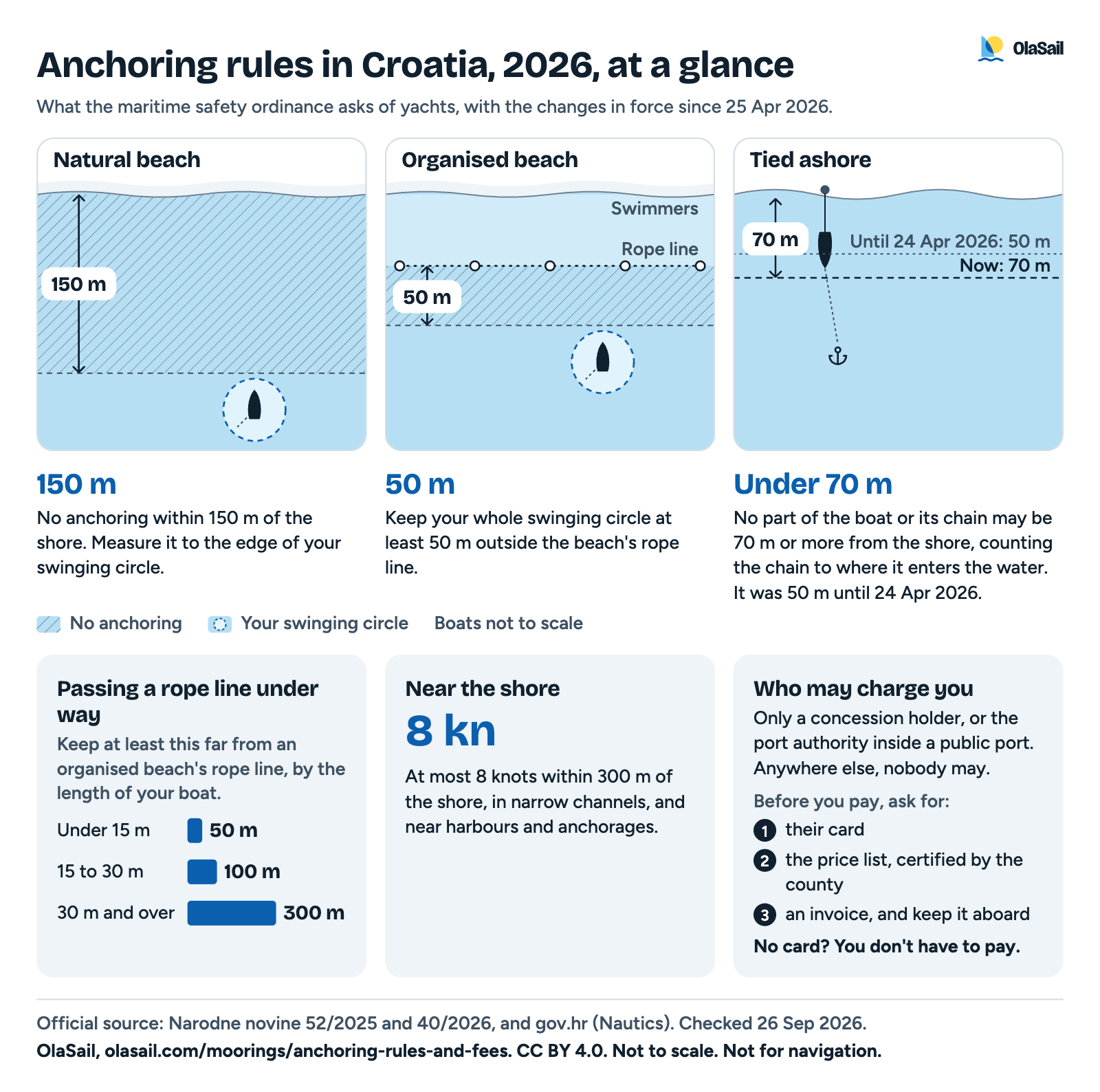
- Keep clear of beaches. Stay 150 m off a natural beach, and keep your swinging circle 50 m outside a beach's rope line. (Official source, ) (Official source, )
- Check the chart for no-anchoring areas, cables and pipes, and follow the harbourmaster's bans. (Official source, )
- Tied ashore, stay tied ashore, no part of the boat or its gear may be 70 m or more from the shore. The anchor chain counts from the tip of the bow or stern to the point where it enters the water (Article 53) from the shore. The limit was 50 m until 24 Apr 2026. The change came into force on 25 Apr 2026. (Official source, ) What changed since 2025
- Only two can charge you: a concession holder or a port authority. Ask for their card, the certified price list and an invoice. (Official source, )

Read the graphic as text
- Natural beach. No anchoring within 150 m of a natural beach, under the 2025 ordinance. (Official source, )
- Organised beach. Keep your whole swinging circle at least 50 m from the rope line of an organised beach (Article 53). (Official source, )
- Tied ashore, no part of the boat or its gear may be 70 m or more from the shore. The anchor chain counts from the tip of the bow or stern to the point where it enters the water (Article 53). (Official source, )
- Passing a rope line. Under way, keep clear of an organised beach's rope line: at least 50 m in a boat under 15 m, 100 m in a boat of 15 to 30 m, and 300 m at 30 m and over (Article 49). (Official source, )
- Near the shore. Within 300 m of the shore, in narrow channels and near harbours and anchorages, go no faster than 8 knots (Article 50). (Official source, )
- Who may charge you. Only a company with a concession for that anchorage, or the port authority inside a public port, may charge you for anchoring. Anywhere else, nobody may. (Official source, )
- The collector. The collector must show a card with the concession grantor and holder, or the port authority, the card number and their own name. (Official source, )
- Price list and invoice. They must show a price list certified by the county, and give you an invoice. Keep it aboard until you leave Croatian waters. (Official source, )
Use this graphic
You may share and adapt it for any purpose, also commercially, under CC BY 4.0. Credit OlaSail and link to this page.
Credit line
Graphic: OlaSail, CC BY 4.0
Embed code
<figure>
  <img src="https://olasail.com/media/anchoring-rules-2026.png" width="1600" height="1588" alt="Anchoring rules in Croatia, 2026, at a glance">
  <figcaption>Graphic: <a href="https://olasail.com/moorings/anchoring-rules-and-fees/">OlaSail</a>, <a href="https://creativecommons.org/licenses/by/4.0/">CC BY 4.0</a>. Official source: Narodne novine 52/2025 and 40/2026, and gov.hr (Nautics). Checked 26 Sep 2026.</figcaption>
</figure>

Can I anchor here?
Answer a few Yes or No questions about the spot you have in mind. Each one follows the rule text or the official guidance, and says how to find the answer.
- 1
Do the chart or the harbourmaster forbid anchoring here?
Official charts mark no-anchoring areas, and harbourmasters publish their bans on the Ministry’s website. (Official source, )
Your answer:
- 2
Are you inside a national park or a nature park?
Kornati, Telašćica, Mljet and Lastovo are the ones most crews reach. (Official source, )
Your answer:
- 3
Is there a beach within 150 m of your swinging circle?
Measure to the edge of your swinging circle: the chain on the bottom plus your boat’s length, all round the anchor. (Official source, )
Your answer:
- 4
Does that beach have a rope line of buoys?
A rope line marks an organised beach. A beach without one may be a natural beach in the town’s plan, and there is no single list to check. (Official source, ) (Third-party source, )
Your answer:
- 5
Is there a cable, pipe or outfall nearby?
They are marked on the chart. Your swinging circle must stay clear of them. (Official source, )
Your answer:
- 6
Is it a concession buoy field, or inside a harbour?
Only these may charge you. The Ministry’s free nIS app shows public ports and nautical anchorages. (Official source, )
Your answer:
Don’t anchor here
Anchoring where it is forbidden is a maritime offence with heavy fines (Official source, ). Find another spot.
Follow the park’s rules
In a national park or a nature park, a boat must keep to the limits set by the park authority's own rules (Article 72) (Official source, ).
Ask the park office where you may anchor or moor before you go in.
Move further out
Treat it as a natural beach. No anchoring within 150 m of a natural beach, under the 2025 ordinance (Official source, ).
Move clear of it
Keep your swinging circle clear of underwater cables, pipes and outfalls (Article 53) (Official source, ).
The rules allow anchoring here, and a fee may be legal
The rules don't tell you if it is safe: check the depth, the holding and tonight's forecast.
The collector must show a card with the concession grantor and holder, or the port authority, the card number and their own name (Official source, ).
They must show a price list certified by the county, and give you an invoice. Keep it aboard until you leave Croatian waters (Official source, ).
If you tie a line ashore, two more rules apply. You may not tie ashore inside a beach's waters, organised or natural, or where an underwater cable or pipe comes ashore (Article 53) (Official source, ).
Tied ashore, no part of the boat or its gear may be 70 m or more from the shore. The anchor chain counts from the tip of the bow or stern to the point where it enters the water (Article 53) (Official source, ).
The rules allow anchoring here, and nobody may charge you
The rules don't tell you if it is safe: check the depth, the holding and tonight's forecast.
If someone asks you to pay, ask for their card. Without one, you don't have to. (Official source, )
If you tie a line ashore, two more rules apply. You may not tie ashore inside a beach's waters, organised or natural, or where an underwater cable or pipe comes ashore (Article 53) (Official source, ).
Tied ashore, no part of the boat or its gear may be 70 m or more from the shore. The anchor chain counts from the tip of the bow or stern to the point where it enters the water (Article 53) (Official source, ).
You said there is a rope line, so mind its distance. Keep your whole swinging circle at least 50 m from the rope line of an organised beach (Article 53). (Official source, )
What the rules say about beaches
The rule is Croatia's maritime safety ordinance, published in Narodne novine, the official gazette, as number 52/2025. It applies to every boat, not only to cruise ships, as some forums still say. (Official source, ) Read the ordinance
The ministry changed the ordinance in April 2026, in Narodne novine 40/2026. The beach distances for boats stayed the same, and boats tied ashore may now lie further out: lines ashore, below. What changed since 2025
No anchoringYour swinging circleNot to scale. Not for navigation.
- Natural beach
- No anchoring within 150 m of a natural beach, under the 2025 ordinance. (Official source, )A natural beach is one that the town or municipality's spatial plan declares and marks as a natural sea beach (Article 45). (Official source, )There is still no official list of natural beaches, and they aren't marked on charts or signposted from the sea. (Third-party source, ) Treat any beach without a rope line as natural, unless you know otherwise.
- Organised beach
- Keep your whole swinging circle at least 50 m from the rope line of an organised beach (Article 53). (Official source, )
- Swinging circle
- Your swinging circle is the chain lying on the bottom plus the length of your boat, all round the anchor (Article 45). (Official source, )
- Lines ashore
- You may not tie ashore inside a beach's waters, organised or natural, or where an underwater cable or pipe comes ashore (Article 53). (Official source, )
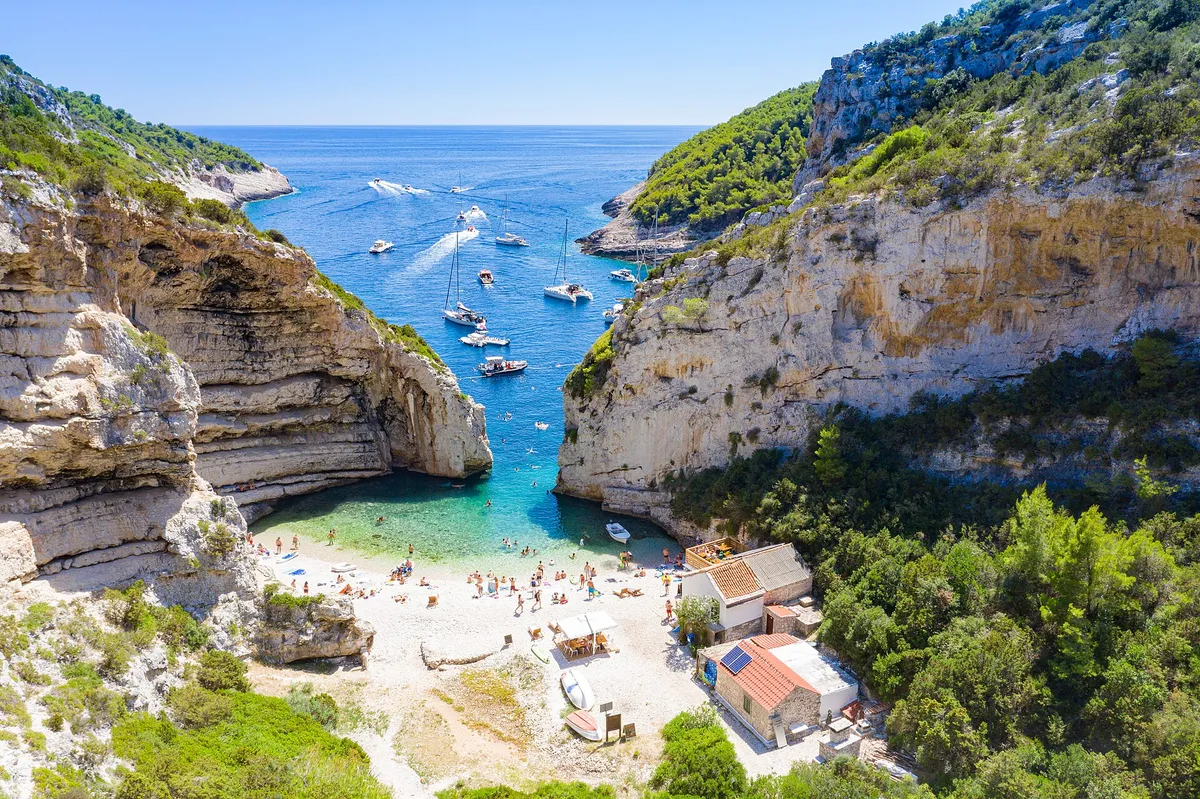
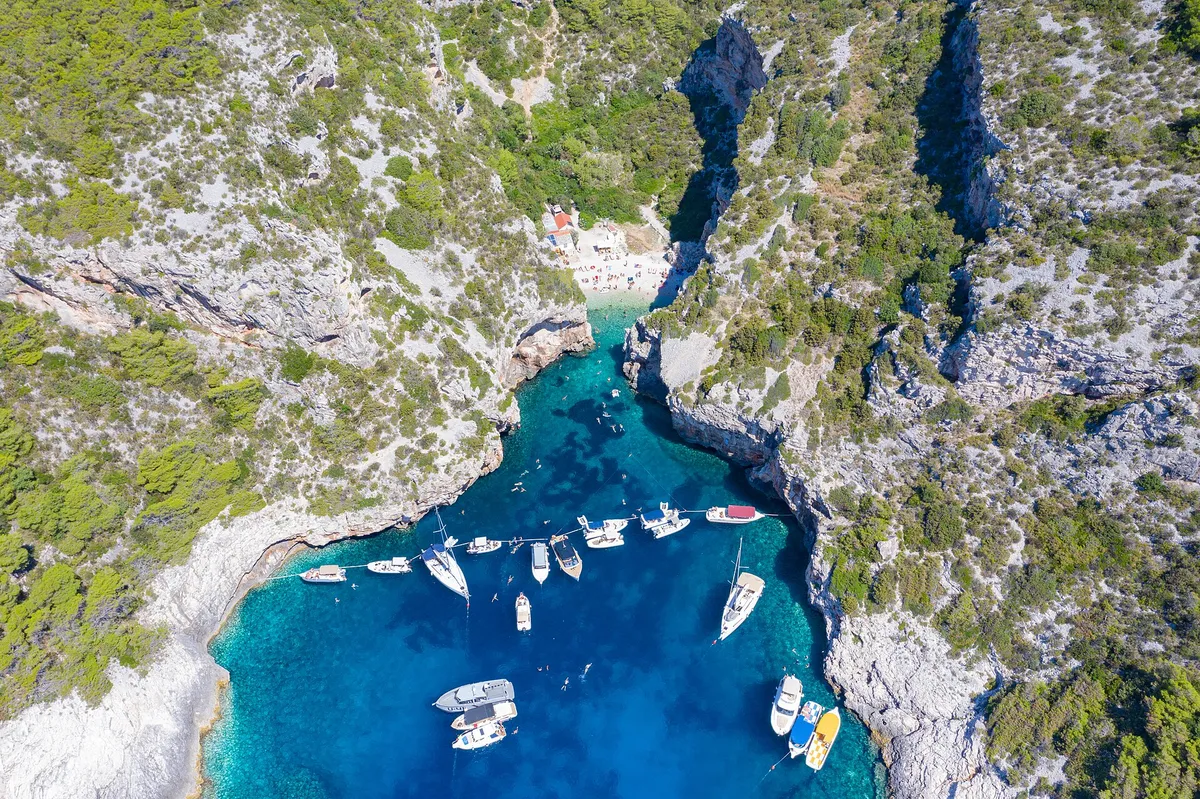
How these rules apply at the swim spots we cover, each on its own page: Stiniva beach by boat, Zlatni Rat from your own boat and the Blue Lagoon on Drvenik Veli.
Other places you may not anchor
- Marked on the chart
- No anchoring where official charts and publications mark it forbidden, or where the harbourmaster has banned or limited it (Article 53). (Official source, )
- Cables and pipes
- Keep your swinging circle clear of underwater cables, pipes and outfalls (Article 53). (Official source, )
- National parks
- In a national park or a nature park, a boat must keep to the limits set by the park authority's own rules (Article 72). (Official source, )
- Seagrass
- Seagrass (Posidonia) is a strictly protected species in Croatia, and anchoring in its meadows badly damages it. Drop the anchor on sand. (Official source, )
- If you get it wrong
- Anchoring where it is forbidden is a maritime offence with heavy fines. (Official source, )
Lines ashore, tenders and speed
Tying a stern line to a rock or a tree is normal in Croatian bays. The ordinance limits how far out you may lie, and the limit changed in April 2026. How to do it, with the crew's jobs: Lines ashore in Med mooring, step by step.
Tied ashore, no part of the boat or its gear may be 70 m or more from the shore. The anchor chain counts from the tip of the bow or stern to the point where it enters the water (Article 53). (Official source, ) The limit was 50 m until 24 Apr 2026. The change came into force on 25 Apr 2026. Lines ashore: what changed
For a 12 m boat, a line ashore of up to about 55 m keeps you inside the 70 m limit, with a metre or two of chain from the bow to the water. (Measured by us, )
- A beach's rope line
- Under way, keep clear of an organised beach's rope line: at least 50 m in a boat under 15 m, 100 m in a boat of 15 to 30 m, and 300 m at 30 m and over (Article 49). (Official source, )The April 2026 changes moved only seaplanes, from 300 m to 100 m. For boats the distances are the same as in 2025. Before and after, rule by rule
- Coming close to the shore
- Keep off the shore itself: at least 50 m in a boat under 15 m, 150 m in a boat of 15 to 30 m and 300 m at 30 m and over, except to enter or leave a harbour, anchor or moor, and then slowly (Article 49). (Official source, )
- Speed
- Within 300 m of the shore, in narrow channels and near harbours and anchorages, go no faster than 8 knots (Article 50). (Official source, )
- The tender
- A tender carried as your yacht's equipment may go up to 500 m from it, except to carry people or things to the nearest landing (Article 49). (Official source, )
Who can charge you, and how much
This is where most arguments start. The official answer is short. Only a company with a concession for that anchorage, or the port authority inside a public port, may charge you for anchoring. Anywhere else, nobody may. (Official source, ) What sailors report is messier, so we keep their reports apart, in What sailors told us.
Mooring fees depend on the place. At Vinogradišće buoys, the published tariff says €7 a metre a night from 1 Jun to 20 Sep, so €84 for a 12 m boat, and €5 a metre in April, May and from 21 Sep to 20 Oct. VAT is included. Booking a buoy costs €30 in high season and €15 in low season. (From the operator, ) The list on the website prints no year and still gives prices in kuna too, so it may be the list of 2023.
At Hvar town quay, Nautički centar Hvar charges €40 a day on the quay for a boat of 10 to 14.99 m, with help mooring, water, power and two 90-litre bags of rubbish. A catamaran is charged as if it were 1.5 times its length. (From the operator, ) With the county's port fee, about €136 a day for a 12 m monohull on the town quay in 2026: the county's port fee of €96 and Nautički centar Hvar's charge of €40. (Measured by us, ) For a marina night, see the Central Dalmatia prices and the charter week cost guide.
- Who may charge
- Only a company with a concession for that anchorage, or the port authority inside a public port, may charge you for anchoring. Anywhere else, nobody may. (Official source, )The Ministry's free nIS app shows public ports and nautical anchorages. (Official source, )In 2024 Split-Dalmatia County adopted a plan of 69 places for managed anchorages, with 109 buoy fields for up to 1,857 boats. It is the basis for future anchorage concessions. (Third-party source, )
- What it costs
- In a public port's anchorage you pay the berth fee less 30% on a buoy, or less 50% at anchor. (Official source, )The fee goes by the boat's overall length, for each day or part of a day. (Official source, )In the Split-Dalmatia county ports, catamarans pay twice the rate per metre. (Official source, ) Catamaran or monohull: the week's berth fees
- The collector
- The collector must show a card with the concession grantor and holder, or the port authority, the card number and their own name. (Official source, )They must show a price list certified by the county, and give you an invoice. Keep it aboard until you leave Croatian waters. (Official source, )
- What it costs in a county port
- In Vinišće, west of Trogir: about €10 a night at anchor for a 10 m boat, by our sum: the berth fee in a class III county port like Vinišće is €2 a metre, and you pay half at anchor with no moorings. (Official source, )A boat of 10.01 to 15 m pays €3 a metre, so €1.50 at anchor. SeaHelp reported a receipt for €15.15 for a 10 m boat on 1 Aug 2026, which is the €3 rate for a boat just over 10 m. Ask to see the price list, and keep the receipt.What a news report found: in summer 2026 the county port authority charged €15.15 a night to anchor a 10 m boat in Vinišće and €21.24 for a 14 m boat: half the berth fee, plus a 1% waste fee. (Third-party source, )
If someone asks you to pay
- Ask for their card. It names the concession holder or the port authority, the card number and the collector. (Official source, )
- Ask for the price list, certified by the county. The fee goes by your boat's length. (Official source, )
- Pay only against an invoice, and keep it aboard until you leave Croatia. (Official source, )
- No card? You don't have to pay. Outside a concession or a public port, nobody may charge you. Note the time and the boat, and tell the nearest harbourmaster's office. (Official source, )
Step by step: Stončica bay
Stončica, on the northeast tip of Vis, is a concession anchorage. Gradina Vis d.o.o. holds the concession (From the operator, ), so a fee inside it is legal. In 2023 a buoy cost €42 a night for a boat of 10.01 to 15 m (€30 up to 10 m, €65 for 15.01 to 20 m), in cash only, paid when you start using the buoy. A night runs to noon the next day, and a day stay until 5 pm costs half. (From the operator, )
Inside the buoy field, use a buoy. The Town of Vis spatial plan sets five anchorages with buoys: Stončica, Rukavac, Veli Budikovac, Ravnik and Ruda. Inside them you moor on a buoy, not on your own anchor. (Official source, )
Outside it, anchoring is free if the beach rules allow it. In the Town of Vis, the spatial plan treats all the shore outside its building areas as natural beaches. (Official source, ) The Town of Vis plan's land-use map shows no settlement building area at Stončica bay, and marks an anchorage in the bay. (Official source, ) So the beach is very likely a natural beach, with the natural-beach distance outside the buoy field. One hatched area at the head of the bay has no class on the map, so our skipper reviewer confirms it before we say so.
A 12 m boat with 30 m of chain on the bottom swings 42 m round its anchor, so near a natural beach drop the anchor at least 192 m from the shore. (Measured by us, ) Depth in the bay: 5 to 6 m in the south of the bay, on sand. (From the operator, ) Fine sand only at the head of the bay, down to 4 m. Elsewhere the bottom is rocky or stony to about 10 m, then seagrass (Posidonia) to 18 m, with fine muddy sand in the deepest middle of the bay. (Official source, )
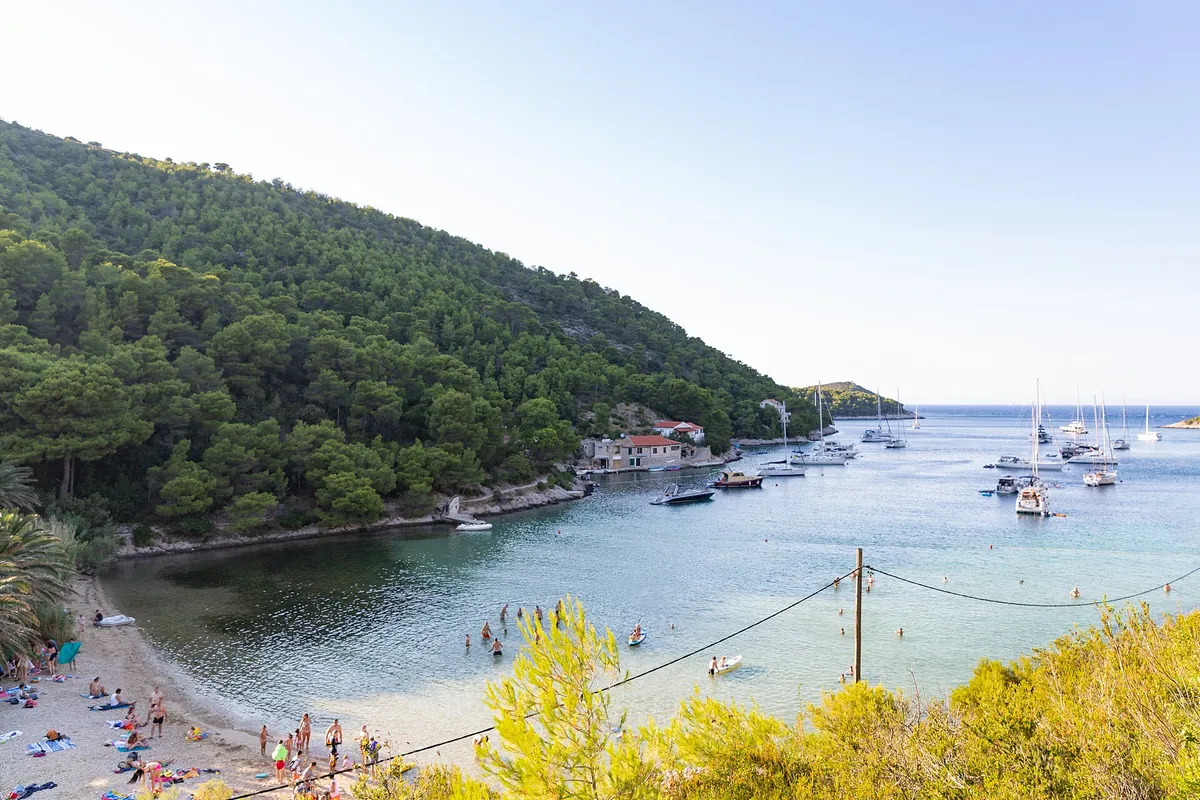
In 2023 a buoy cost €42 a night for a boat of 10.01 to 15 m (€30 up to 10 m, €65 for 15.01 to 20 m), in cash only, paid when you start using the buoy. A night runs to noon the next day, and a day stay until 5 pm costs half. (From the operator, ) The fee, shelter by wind, and where to go if it's full.
Open its pageEvery buoy field and harbour we have checked is in Where to stay the night.
What sailors told us
What sailors report about anchoring, fees and collectors. We haven't checked these reports, they don't count in our checks above, and they are never the rule.
A sailor was charged "€4 a metre" to anchor in a bay at Cavtat, with no buoy. Who collected it is not known.
A sailor who keeps a boat in Croatia wrote in June 2026 that the man collecting buoy fees is meant to take your rubbish, so with a locker full of it they sometimes pay about €30 for a buoy.
Over 17 days in high season from Pula to Lastovo and back, a charter skipper spent 6 nights in harbours, 3 on buoys and the rest at anchor, and found anchoring in the north and Kvarner almost never a problem.
A sailor who charters four times a year wrote in March 2026 that buoys cost about €30 to €50 a night in the north and somewhat more in the south, with a few asking €100 for a 45 ft boat, and that village harbours start at €50.
Still right? Were you there this season? Tap the small mark after any fact on this page, then "Yes, I saw it".
Help keep this page right
Found something different on the water this season? Tell us what you found. We check it with the source before anything changes.
Other ways to helpSources
40 facts from 20 sources, last checked .
Show all 20 sourcesShow fewer sources
Photos on this page